

How to Spot a Counterfeit Car Seat
2026 Safety Guide & The CAR SEAT Act
A new federal bill aims to combat the rise in noncompliant and counterfeit car seats. The Child Automobile Restraint Safety Education and Training (CAR SEAT) Act would require the secretary of transportation to launch an education campaign focused on the dangers of non-compliant or counterfeit child restraint systems, such as car seats and booster seats.
“We're seeing a large amount of counterfeit or non-compliant car seats come on the market, and they are a real safety hazard because they don't meet the testing standards,” said Sharon Evans, trauma injury prevention manager at Cook Children's Health Care System.
Evans says the health care system has seen more than 15 counterfeit car seats since 2021.
The Hidden Cost of "Cheap" Seats
Experts from Cook Children's Health Care System, Viviana Esparza, program coordinator at the Center for Community Health, and Evans warn that while fake seats save money upfront, they fail when it matters most.
“The health and wellbeing of our children is of highest concern,” said Esparza. “The cost of a car seat doesn’t compare to the safety of a child.”
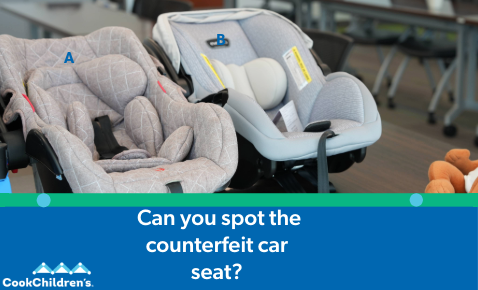
While counterfeit seats appear to be bargains, the price difference is often deceptive. Evans and Esparza recently encountered a knockoff Doona car seat at a safety event that cost $300, compared to the $650 retail price for a legitimate model.
“Often, parents are buying these from third-party sellers on TikTok Shop and Amazon,” Evans explained. 
Red Flags: How to Identify a Fake
When shopping for car seats, Evans advises parents and caregivers to watch for counterfeits of popular brands. These knockoffs are often cheaper than their legitimate counterparts anddo not meet regulations to protect a child in the event of a car crash.
Look for these warning signs:
Materials: The plastic shell may feel thin, flexible, or even hollow.
Harnesses: The chest clip may be missing, or the harness straps may not conform to U.S. width standards.
Missing Documentation: Instructions may be missing or provided only in foreign languages.
Lack of Labeling: Legitimate seats must have side labels with installation guides, weight limits, and manufacture dates. Fakes often have no labels or labels with poor grammar and typos.

Three Steps to Ensure Your Seat is Safe
- Buy Direct: Buy directly from the manufacturer or a reputable retail store.
- Call the seat manufacturer: They can help you determine if it’s a knockoff and will sometimes ask you to submit photos.
- Certified Child Passenger Safety Technician (CPST): Take your car seat to be checked by a certified child passenger safety technician. They are trained to help determine if it’s fake.
Where to Get Help
Evans recommends parents and caregivers with a new car or booster seat, schedule a free inspection with a CPST.
- Visit freecarseatcheck.org and click “Book your appointment”
- Find a child passenger safety technician at safekids.org
- Find an inspection station through The National Highway Traffic Safety Administration
If you discover the seat is a fake, stop using it immediately. Report the seller to the retailer and file a report at StopFakes.gov or with NHTSA.
Poll


