

Big Game, Big Responsibility: Water Safety
Memorial Day weekend marks the unofficial start of summer, drawing eager families to local pools and lakes. To ensure those fun days stay safe, Cook Children’s Health Care System’s Lifeguard Your Child campaign equips parents with the tools to create a water safety plan. This mission takes on a global scale this summer; as North Texas prepares to welcome the World Cup, thousands of international visitors unfamiliar with Texas waters will arrive. Cook Children’s experts are stepping up to keep every little one safe. A key part of this community-wide effort includes Cook Children’s Loaner Life Jacket Stations, which ensures that no child or adult is left unprotected at a public lake simply for lack of a life jacket.
“Cook Children's is really invested in prevention in our community, and it's written into our promise,” said Jillian Mitchell, program coordinator for the injury prevention team at the Center for Community Health.
Drowning is the leading cause of injury for children ages 1 to 4 at the highest risk. According to the 2024 Community Health Needs Assessment, Cook Children’s Medical Centers in Fort Worth and Prosper treated 224 drowning-related injuries from 2021 to 2023. These incidents occurred in bathtubs, open water (lakes, rivers, and ponds), and pools or hot tubs.
Cook Children's Health Care System shows a slight decrease in drownings in the last five years:
Year | Number of Cases |
2021 | 80 |
2022 | 84 |
2023 | 65 |
2024 | 100 |
2025 | 75 |
Mitchell notes that as summer vacation and hot weather arrive, families will be looking to cool off, but months may have passed since the last dip in the pool.
“As we're heading out to any kind of open water or to a pool, it's important to have preparation top of mind,” said Mitchell.
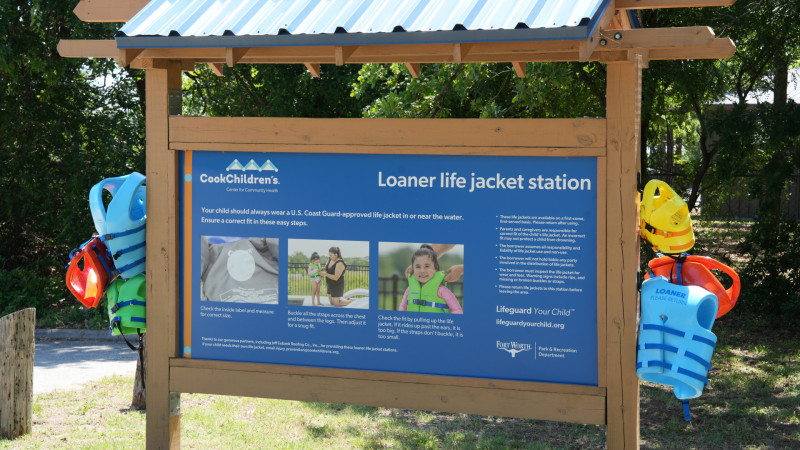 Lifesaving Access: Loaner Life Jacket Station
To help protect swimmers in open water, Cook Children’s supports more than 60 Loaner Life Jacket Stations across North Texas. The stations provide five different sizes of U.S. Coast Guard-approved life jackets, ranging from infant to adult, which families can borrow and return free of charge. Each station features educational graphics detailing how to properly fit and secure the vests.
Local officials at Lake Worth report that the stations are heavily utilized, with life jackets consistently borrowed and safely returned by the end of each weekend day.
“We want to make sure that that resource is available for families that maybe don't have the opportunity to get a life jacket for their child,” said Mitchell. In 2025 alone, the program distributed more than 1,800 U.S. Coast Guard-approved life jackets to area lakes across Tarrant, Denton, Rockwall, and Stephens counties.
Water Safety Tips 
- Transition time
- Make sure to put a life jacket on children before you get out of the car.
- If a child goes missing, check the water first.
- Designate a Water Watcher to ensure constant visual supervision.
- A Water Watcher should be in-reach of the children in the pool.
- A 10-15 minute shift rotation is recommended. During that time, Water Watchers should not be distracted by conversations, cell phones, reading, etc.
- Keep backyards and bathrooms safe.
- Dump all water buckets and empty kiddie pools when they are not in use.
- Install multiple barriers in areas leading to pools and spas: pool fences, self-closing, self-latching gates and door alarms.
- Keep the pool area picked up and clear of toys and other items which might attract an unsupervised child.
- Never leave children unattended in the bathtub.
- Wear “U.S. Coast Guard-Approved” or “USCG approved,” life jackets
- As your child grows, the life jacket needs to meet their new weight.
- Get a new life jacket if there are rips and tears or if the straps are fraying.
- Do not rely on floats or other toys to keep children safe.
- Sign up for CPR and swim lessons.
- The American Academy of Pediatrics recommends starting children in swim lessons as young as 12 months old to reduce the risk of drowning.
- The National Drowning Prevention Alliance provides parents with a printable questionnaire to help identify the right swim program for their children.
- Have a safety plan in place.
- If an emergency does happen, remember that seconds count. Call 911 immediately and then begin CPR while EMS is in route.
- Know water conditions before you get into open water. Water conditions in lakes and oceans can vary on a daily basis.
- Sit near a lifeguard if there is one present.
"Combining swim lessons, life jackets, dedicated water watchers, brightly colored swimsuits, and pool fences creates multiple layers of protection," Mitchell said. "The more layers of safety you put in place, the lower the risk of drowning."
Lifeguard Your Child ™ Campaign
Cook Children's Lifeguard Your Child Campaign encourages parents everywhere to create a safety plan for ANY time their children are around water—whether its swim time, unplanned time around water, or even bath time. Water safety is important at any age, and when it comes to drowning, every second counts. It’s silent and can happen in an instant. Drowning is the leading cause of death for children ages 1 to 4, and the second leading cause for kids ages 1-14 in Texas. But with your help, we can change that. Together, we are asking everyone to Lifeguard Your Child around water. Click here to learn more about how to get involved or create an awareness campaign in your community.
