

The Power of Prevention: Cook Children's Reports a Drop in Drownings
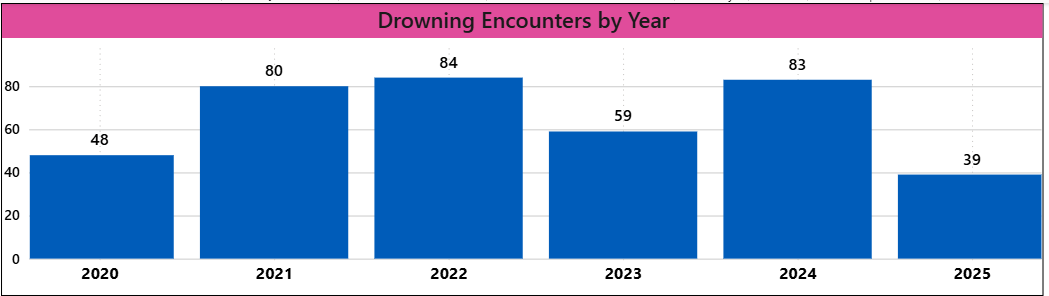
As summer comes to a close, Cook Children’s Health Care System reports a decrease in drownings over the past two years. The Cook Children’s Center for Community Health has placed a strong focus on prevention efforts.
“A drowning can occur in any body of water at any time,” said Jillian Mitchell, community health program coordinator at Cook Children’s Health Care System.
Mitchell explains that data shows infants have the greatest risk for drowning inside the home, while children ages 1-4 have the greatest risk for drowning overall. Cook Children’s has developed strategic partnerships and efforts to inform and educate families on water safety.
“After seeing that a majority of drownings were occurring during a planned swim time, it became clear that strong messaging around adult supervision is key,” said Mitchell.
Eighty-eight percent of drownings occur with at least one adult present. The “Lifeguard Your Child” program teaches parents how to create a safety plan for children anytime they are around water.
Those tips include:
- Designate an adult Water Watcher to ensure constant visual supervision of children in and around water.
- Implement 15-minute shifts for Water Watchers.
- No Distractions: The Water Watcher must have no distractions, including conversations, phones, reading, or consuming alcohol.
“We know that distractions are a key component of unintentional injuries around planned swim time, so sharing these messages are strong reminder that drowning-related injuries and fatalities are preventable with non-distracted supervision,” said Mitchell.
Swim Lessons
Learning to swim can reduce drownings by more than 80%. Cook Children’s recognizes there is a disparity in access to swim lessons and saw an opportunity to collaborate with swim schools in the community. As a result, free Water Safety lessons are provided in select areas in under-resourced neighborhoods through community partnerships.
“By committing to taking a multi-layered strategic approach, the goal is to encourage safer choices in and around open water activities,” said Mitchell.
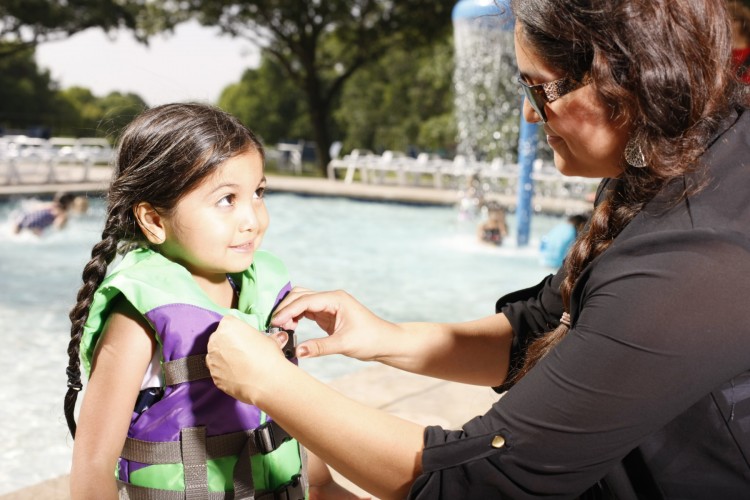
It is not just pools but ponds and lakes where water safety is important, and life jackets can help. Cook Children’s has a partnership with the Brazos River Authority in Granbury and Possum Kingdom Lake to provide water safety education at local schools and camps. The efforts extend into more than a dozen counties with loaner life jacket stations that Cook Children’s has built and supports.
“We hope to instill the importance of choosing the safest floatation device for their child,” said Mitchell. She adds that life jackets are not a substitute for supervision.
Choosing the right life vest:
- If the lifejacket does not say “U.S. Coast Guard-Approved” or “USCG approved,” you can assume it is not safe. Always check the label.
- As your child grows, the lifejacket needs to meet their new weight.
- Get a new lifejacket if there are rips and tears or if the straps are fraying.
- Do not rely on floats or other toys to keep children safe.
- Always assign an adult water watcher when children are swimming, even if they are fitted with a life vest.
Water safety is year-round 
Mitchell adds that water safety continues well into the winter months. Drowning can happen in only an inch or two of water, just enough to cover your child’s nose and mouth. Last year, Cook Children’s saw an uptick in bath-related drownings.
“We know that bath-related drownings are 100% preventable,” said Mitchell. “Much of our education focuses heavily on behavior change around preparedness, 100% adult supervision, and general safety concepts.”
- Ensure an adult stays at the side of the tub within reach of the child throughout the entire bath. This is too big of a responsibility for siblings and other children, so don’t ask them to take over for you.
- Avoid multitasking. Preparing dinner, folding laundry, or any other housekeeping tasks can and must wait until after the bath is over.
- Ignore distractions like the doorbell or cell phones. Stepping or looking away from your child for even a few seconds can put them at risk of drowning.
- Be prepared. Keep a towel and bath supplies close at hand, so you do not need to get up and leave during bath time.
- Treat every bath as a time to relax and bond with your baby or toddler. Bath toys like foam letters, animals that shoot water, and waterproof books are a great way to make the bathtub more fun and teach your child new things at the same time!
- Safety proof your home to prevent young children from accessing the bathroom without an adult. The more barriers in place, the safer your child will be.
- If you absolutely have to leave during bath time, swaddle your child in a towel and bring them with you.
- Remove all toys and drain the tub immediately after each use.

