

What is an Advanced Practice Provider?
During Advanced Practice Provider (APP) week, learn more about this unique role with a Q + A session with three Cook Children's APP's.
Advanced Practice Providers (APP) are integral members of the health care team that promote and support the delivery of high-quality, safe, and effective care here at Cook Children’s. What does that encompass? APPs consist of all types of advanced practice nurses (nurse practitioners, certified registered nurse anesthetists, clinical nurse specialists, and certified nurse midwives) and physician assistants.
Our APPs collaborate with our physicians to provide care to our patients in a variety of clinical settings. From the medical centers, to our urgent cares, to the Dodson surgery center and specialty clinics, and many of our neighborhood and primary care clinics, APPs are able to provide a comprehensive range of health care services to our patients. With over 445 APP’s in our organization, each of them practice in almost every specialty and their group continues to grow in numbers.
To celebrate Advanced Practice Providers Week, we sat down with three of our APP's to learn a little more about this unique role.
Katy Diggs, Physician Assistant
- What is your role and what does it entail?
- “I am a certified physician assistant in the Orthopedic Surgery Department at Cook Children's Medical Center - Fort Worth. I work primarily in the outpatient clinic setting, seeing mostly fractures and acute injuries. We do a lot of casting and X-rays. We are so busy this time of year… football season!”
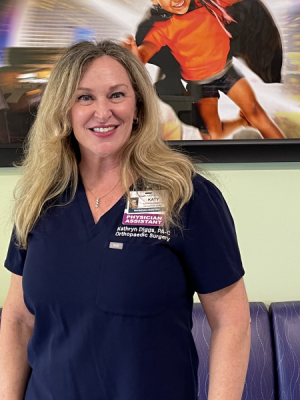
- “I am a certified physician assistant in the Orthopedic Surgery Department at Cook Children's Medical Center - Fort Worth. I work primarily in the outpatient clinic setting, seeing mostly fractures and acute injuries. We do a lot of casting and X-rays. We are so busy this time of year… football season!”
- What does a “typical” day in the life of a physician's assistant look like?
- “A typical day for me in the outpatient clinic setting is seeing about 20 to 25 patients, mostly with fractures and acute injuries. I'm on call shift every Monday. The call shift work is super busy but fun. There are many trips to the emergency room to evaluate fractures or trauma, and many trips to the operating room to treat those injuries. My team and I are the first call for the practice, answering all UCC, ER, pediatrician, specialty, nurse and patient calls.”
- How long have you been with Cook Children’s?
- "I have been at Cook Children's for 20 years and truly still enjoy the work!"
- How have you seen your program grow over the years?
- "The orthopedic surgery department has grown so much in the last several years. We have many new doctors and APPs. All have been a wonderful addition to the team!"
- What is a memorable or inspiring patient story you carry with you?
- "I have so many memorable and inspiring patient stories that I don’t know where to begin. Kids are great and so much fun to work with. I sincerely appreciate and find myself inspired by every single patient and/or their family every day. Life is hard, work is hard, but kids make everything so much better. They are funny and happy. They want to heal quickly and get back to having fun. That is inspiring!"
Roland Thomason, Certified Registered Nurse Anesthetist
- What is your role and what does it entail?
- "As a Certified Registered Nurse Anesthetist (CRNA) for Cook Children's, I work with the anesthesiologists, providing a safe anesthetic for each patient requiring surgery or radiology study."
- What does a “typical” day in the life of a CRNA look like?
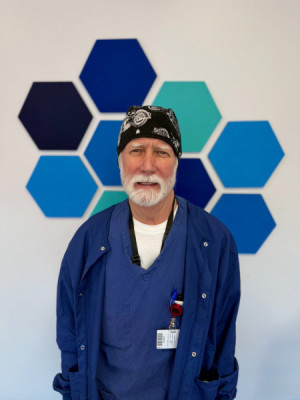
- “My typical day begins at 6:30 a.m. I check on my assignment for the day to see which operating room (OR) I am assigned to. I then review the patient’s chart, and then I get each case ready by pulling the medicine and materials needed for each anesthetic. I then go and introduce myself to the patient and family. I have a conversation with the anesthesiologist regarding the anesthetic to be provided. First patient is brought to the OR, monitors are applied, anesthetic is administered either through mask inhalation or if the patient has an IV, then we administer medication through the IV. Conversations continue with the surgeon seeing what the patient needs. I monitor the patient throughout the entire procedure. Once the procedure is finished, the patient is taken to the Recovery Room.”
- How long have you been with Cook Children’s?
- “35 years.”
- How have you seen your program grow over the years?
- “I was here when Cook Children's first opened. We had approximately ten CRNAs. Today, there is in excess of 65 CRNAs. More surgeons, MDAs and operating rooms have increased as well. Roles have expanded in general surgery, neurology, orthopedics and cardiology. We have enlarged our program for training SRNA’s in pediatric anesthesia.”
- What is a memorable or inspiring patient story you carry with you?
- “I’m touched and impacted nearly daily by the valor of a child or teen facing a life-threatening diagnosis and the treatments that follow. One patient of mine struggled with a life-threatening diagnosis. Though he had multiple procedures over many years, he always had a smile on his face.”
Ginny Ciriot, Pediatric Nurse Practitioner
- What is your role and what does it entail?
- “I am a Pediatric Nurse Practitioner in primary care. I see both ill patients and well visits, which I love.”
- What does a “typical” day in the life of a nurse practitioner look like?
- “My typical day is always busy with visits. I generally see between 25 and 32 patients. Then, between patients, I also have to check triage for calls and answer the triage nurse, result follow-up, and prescription requests.”
- How long have you been with Cook Children’s?
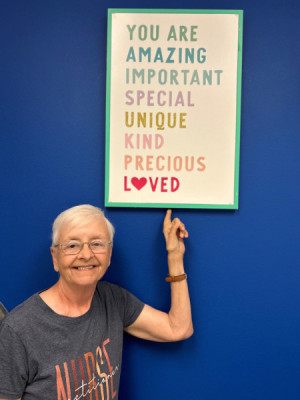
- “I have been with Cook Children's for 49 years and have spent the last 30 in primary care. My employee number is 2 digits! During my 19 years at the hospital, I was in the NICU for 6, then became the first NICU Educator for both Fort Worth Children’s and Harris’ NICUs as we had a consortium between the 2 hospitals. Then I became the first Director of Education for Cook Children's and centralized the educators. I also became a clinical resource nurse for the floors. All this was amazing, but it was taking me away from patient care. That is when I sought out the PNP program. And was the first PNP in primary care for CCPN.”
- How have you seen your program grow over the years?
- “My practice has changed from paper charts to electronic, and prescription pads to electronic. I am now seeing the children of my former patients!”
