

Seventh Grader With ADHD Embraces His Superpowers
In honor of ADHD Awareness Month, Cook Children’s patient Deacon Swaim shows how neurodiversity can be a strength.

When 12-year-old Deacon Swaim sits at his desk in math class, his peers might notice how focused he is. What they don't see is the journey that led him there.
Deacon is one of just 16 students selected out of 332 to participate in his grade’s accelerated math and science program. He also has Attention-deficit/hyperactivity disorder (ADHD)—a fact that might surprise people given his academic achievements.
"I'm always the quiet kid, but I'm really smart," Deacon says, prompting a laugh from his mother Jennifer Swaim. She adds, "Yes, and humble!"
Early Signs of ADHD
Jennifer, who has worked in the Cook Children's psychology department for almost 17 years, said she recognized signs of ADHD in Deacon when he was still a toddler.
"He's always been a kid that is full of energy," Jennifer said. "We have videos of him sitting on the ottoman in front of the TV, constantly bouncing because he couldn't physically contain himself."
According to Deacon’s psychiatrist—Kristen Pyrc, M.D., medical director of Psychiatry Outpatient Services and the Partial Hospitalization Program at Cook Children’s Medical Center – Fort Worth—ADHD presents in three different ways.
"One is the inattentive type where you have trouble with details and staying on task. The second kind involves hyperactivity and impulsiveness. These are the kiddos who you can spot from across the room because they have a ton of energy," she explains. “The third type combines both characteristics.”
The Path to Diagnosis
While Jennifer recognized the signs early, she waited to pursue formal testing until Deacon’s ADHD began affecting his daily life. His early elementary school years were manageable thanks to a brain-based learning environment that incorporated group work, frequent breaks, and movement.
However, by fourth grade, Deacon started encountering challenges. "If it got too loud in class my ears would start to ring and it made it difficult for me to concentrate and get work done," he recalls.
In 2021, Deacon had a full psychological evaluation at the Cook Children’s Denton Psychology clinic, which confirmed his ADHD diagnosis. At the time of his diagnosis, Jennifer worked in the same building as Dr. Pyrc and asked her if she would be comfortable seeing Deacon, since she was already seeing his older brother Joshua. Dr. Pyrc agreed and has been working with Deacon ever since.
"We tell parents we would think about treating ADHD if it causes impairment in functioning," Dr. Pyrc said. "So if your child is constantly getting in trouble at school or it's really affecting their academic performance, that's when we think about starting treatment."
Both Jennifer and Dr. Pyrc added that consulting with a pediatrician can help parents make an educated decision on if, and when, to pursue a formal diagnosis.
The Power of Understanding and Support
Before his diagnosis, Deacon often felt like he was doing something wrong.
“For a lot of kids who are on the hyperactive end of ADHD, they are told ‘no’ all the time. Don't do this, don't do that,” Dr. Pyrc explains. “As a result, many of these kids can start to feel defeated and stop caring about school.”
“I think part of it is just validation,” Jennifer said. "It helps Deacon to know he’s not doing anything wrong, his brain is just wired this way.”
After Deacon’s diagnosis, he was met with nothing but support and compassion from his teachers at school. One of his teachers has a child with ADHD and was able to work with him on a game plan to support him in the classroom.
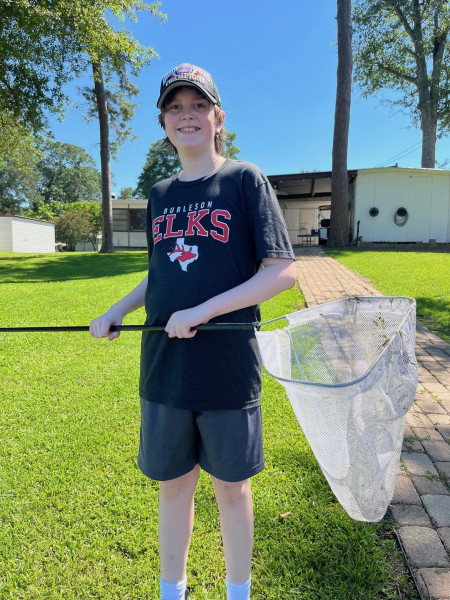 Now, Deacon even has several friends with ADHD, including a buddy from kindergarten who has since moved out of state. The pair stay in touch by playing video games together, bonding over their shared experiences. Deacon also finds support in hanging out with his dog Winston, who he says helps him regulate his emotions.
Finding The Right Treatment
For Deacon, medication has been an effective tool for managing his ADHD and staying focused at school. According to Dr. Pyrc, medications are highly effective in treating core ADHD symptoms like hyperactivity and impulsivity and can give kids a sense of autonomy.
An ADHD brain, Dr. Pyrc explains, has a tendency to explore mental “rabbit trails”—which can be great for creativity, but not for subjects like math. Medication can help kids stay on task by providing helpful mental guardrails for clarity and focus.
Though some parents worry about medication dependency, Dr. Pyrc notes that untreated ADHD actually poses a higher risk for future substance abuse issues than the medications themselves. She emphasizes that therapy can also help kids regulate and process their emotions and develop coping skills.
“There's a whole host of other skills that these kids need to be successful in school, like an organizational system or being able to finish tasks,” she explains. “For those types of skills and systems, therapy can be a helpful supplement to medication.”
ADHD as a Superpower
Dr. Pyrc commonly reassures her patients that ADHD can be like a superpower.
 "Kids with ADHD tend to be more creative because their brain takes those rabbit trails,” she explains. “They work really well in groups because they think outside of the box, and they're very energetic."
Deacon's creativity shines through in multiple ways. He plays euphonium in his school's honors band, dabbles in ukulele and guitar, and enjoys sketching. He also loves challenging video games and all things science—especially learning about space and the universe. Deacon’s passion for building with Legos without instructions shows his innovative thinking.
"It's really cool to see what people can do with just their mind and a couple of bricks," he said.
In fact, Deacon feels his ADHD has actually improved his ability to focus.
"I learned to work hard at getting myself to do better and pay attention," he explains. "In certain subjects, I am one of the most focused ones in my class."
Over the years, Dr. Pyrc has seen Deacon’s confidence grow as he’s come into his own and discovered his strengths.
“To see Deacon’s personality shine through is always the best part for me,” Dr Pyrc said. “He is such a bright and kind kid who is good at so many things and so creative, so I always love to hear what he's up to and what's challenging him.”
Dr. Pyrc encourages parents to remember that while ADHD can be frustrating at times, children are doing their best. She emphasizes the importance of helping them develop the skills they need to be successful—and giving them grace throughout the journey.
October is ADHD Awareness Month. If you're concerned your child might have ADHD, talk to your pediatrician. They can help determine what's standard for your child's age and connect you with appropriate resources as needed.
About Cook Children's Health Care System
Cook Children’s is more than a health care system: we strive to be an extension of your family, growing with your child from their first steps to adulthood. By collaborating to deliver on our Promise—to improve the well-being of every child in our care and our communities, we connect the dots for our patients. Between primary and specialty. Between home and medical home. Between short-term care and long-term health.
Based in Fort Worth, Texas, we’re 9,700+ dedicated team members strong, passionately caring for over 2 million patient encounters each year. Our integrated, not-for-profit organization spans two medical centers (including our state-of-the-art location in Prosper), two surgery centers, a physician network, home health services and a health plan. It also includes Child Study Center at Cook Children's, Cook Children's Health Services Inc., and Cook Children's Health Foundation. In 2024, Forbes named Cook Children’s the top health care employer in the U.S., and third on the list of ‘America’s Best Large Employers.’
And our impact extends beyond the borders of Texas. We proudly treat children from virtually every state in the nation and 32 countries. By seeing the world through the eyes of children and their families from all backgrounds, we’re able to shape health care suited to them: connected by kindness, imagination and respect—with an extra dose of magical wonder.
Discover more at cookchildrens.org.
