

Cook Children’s Lead Neurosciences Researcher Addresses Congress Members on Capitol Hill
Dr. Papadelis wants to share his enthusiasm for the strides his team at Cook Children’s is making to help patients with drug-resistant seizures.
By Jean Yaeger
A panel of scientists addressing U.S. Congress members on Wednesday includes Professor Christos Papadelis, Ph.D. representing Cook Children’s research and innovation to treat pediatric epilepsy.
Dr. Papadelis leads the Neurosciences Research Center at Cook Children’s, which undertakes groundbreaking studies and collaborates in the care of patients with seizures. 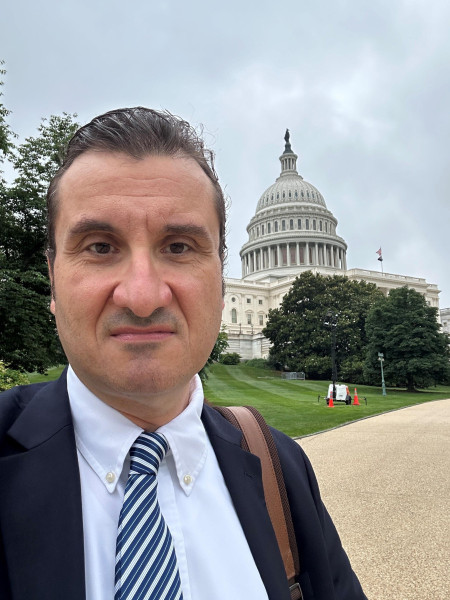
He’s among the experts invited to speak at the Rayburn House Office Building in Washington, D.C. as part of Brain Mapping Day. The Society for Brain Mapping and Therapeutics (SBMT) sponsors the annual event. Its goal? Educating federal lawmakers about current approaches to treating neurological and psychological disorders.
Brain Mapping Day also aims to shape future policies and funding for health care by promoting new strategies to advance the neurosciences.
“It’s a fascinating field, and so much progress has been made in the last several years,” Dr. Papadelis said. “But so many things should be done to translate the existing technology to the clinical practice. We need more interface between the translational research and the clinical teams to bridge them together.”
Dr. Papadelis wants to share his enthusiasm for the strides his team at Cook Children’s is making to pinpoint the exact location of the brain where seizures originate in patients with epilepsy. He and his research colleagues combined two types of imaging that measure the brain’s electrical and magnetic activity. When a patient needs surgery to control their drug-resistant seizures, the researchers can provide the neurosurgeon with the precise point of seizure activity. That mapping tool helps ensure a successful surgical outcome while minimizing the risk of complications in other areas of the brain.
Dr. Papadelis earned a spot in the lineup of presenters because of his insights and leadership in neurosciences research. He’ll address House members and congressional staff in a portion of the program titled “Detecting Neurological and Neuropsychiatric Disorders Earlier Using Brain Screening Protocols. What Should Be the Policy?”
His overview covers three main points:
- Effective technology is already available.
- Many patients can’t access the technology because they lack health insurance, or insurance approval is delayed, or other barriers.
- More research funding from the National Institutes of Health (NIH) is needed to continue to make advancements.
He plans to talk specifically about pediatric epilepsy. He wants to make the audience on Capitol Hill aware of the research Cook Children’s is doing to help patients become seizure free – and how policies in health care affect those efforts.
M. Scott Perry, M.D., epileptologist and head of Cook Children’s Jane and John Justin Institute for Mind Heath, said the high-level research by Dr. Papadelis and his team is resulting in better understanding of nervous system disorders. Their contributions are getting noticed and putting Cook Children’s on the map.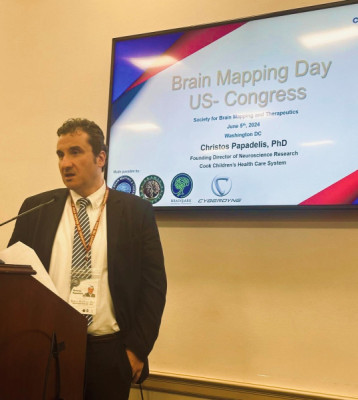
Dr. Perry said he hopes Dr. Papadelis’ presentation in Washington, D.C. attracts additional collaborators and brings more exposure to the Cook Children’s research model, which operates outside of a traditional academic setting.
“By focusing on research that delivers near-term benefits to the patients we serve daily, Cook Children’s is able to grow a strong bond between clinical medicine and research that benefits our patients, our medical providers, and our research team -- all in the course of day-to-day practice of medicine,” Dr. Perry said.
William Stigall, M.D., Chief Research Officer, said the invitation to participate in Brain Mapping Day reflects a growing recognition of the research and clinical excellence at Cook Children’s. He credited Dr. Papadelis with academic depth and rigor that complements the work of Dr. Perry and other physicians on the clinical side.
“Dr. Papadelis and physicians at Cook Children’s are performing cutting-edge research and are extraordinarily well positioned to offer insights to our nation’s leaders,” Dr. Stigall said. “The more the rest of the world knows about us, the better the rest of the world will be.”
More about Dr. Papadelis
Born in Athens, Greece, Dr. Papadelis earned a doctorate in Medical Informatics. After stretches of research in Japan and Italy, he came to the United States in 2011 as an instructor in Neurology at Harvard Medical School. He was founding director of the Clinical Magnetoencephalography (MEG) Program at Boston Children’s Hospital.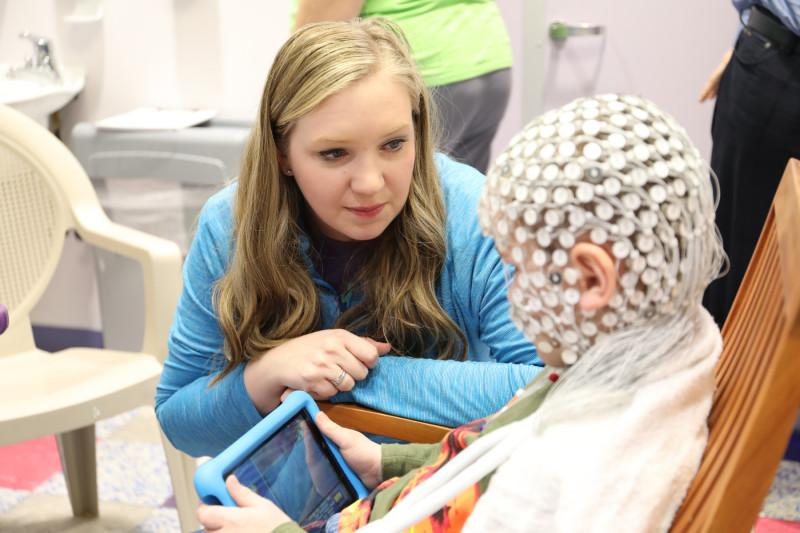
He moved in 2019 to the Neurosciences Research Center at Cook Children’s in Fort Worth. He also is a Professor of Pediatrics at the Texas Christian University Burnett School of Medicine and of Research in Bioengineering at the University of Arlington.
He’s excited to tell policymakers about a five-year brain-mapping study he’s undertaking, funded by a $2.3 million grant from the NIH. Dr. Papadelis described the project as a unique technique that uses more than 550 sensors on a patient’s head to simultaneously record electrical and magnetic activity in the brain.
“This setup we have here is unique in the country and helps us to identify non-invasively and with high precision the area in the brain to be ablated or resected in surgery in order for patients with drug-resistant epilepsy to become seizure free,” he said. With additional NIH funding, he said, more progress can be made across neuroscience.
He points out that the Justin Institute at Cook Children’s bridges the gap between research and clinical application. The two areas connect to integrate new technology in ways that directly impact the patients.
Dr. Papadelis, a naturalized American citizen, said he’s honored by the opportunity to share his perspective at the Capitol. And he’s proud to represent Cook Children’s and his research colleagues.
“We're motivated, and we have passion for what we're doing,” he said. “Although we're not physicians, we work closely with the clinical teams, and that relationship helps us feel a responsibility to these kids and families. Every time I see patients in the elevator, for example, I feel emotional. I'm part of helping these kids.”
RELATED STORIES:
History in the Making: Cook Children's Secures HIH Grant
Major Scientific Discovery from Cook Children's Neuroscience Research Center
About Cook Children's
Cook Children’s is more than a health care system: we strive to be an extension of your family, growing with your child from their first steps to adulthood. By collaborating to deliver on our Promise—to improve the well-being of every child in our care and our communities, we connect the dots for our patients. Between primary and specialty. Between home and medical home. Between short-term care and long-term health.
Based in Fort Worth, Texas, we’re 9,700+ dedicated team members strong, passionately caring for over 2 million patient encounters each year. Our integrated, not-for-profit organization spans two medical centers (including our state-of-the-art location in Prosper), two surgery centers, a physician network, home health services and a health plan. It also includes Child Study Center at Cook Children's, Cook Children's Health Services Inc., and Cook Children's Health Foundation. In 2024, Forbes named Cook Children’s the top health care employer in the U.S., and third on the list of ‘America’s Best Large Employers.’
And our impact extends beyond the borders of Texas. We proudly treat children from virtually every state in the nation and 32 countries. By seeing the world through the eyes of children and their families from all backgrounds, we’re able to shape health care suited to them: connected by kindness, imagination and respect—with an extra dose of magical wonder.
Discover more at cookchildrens.org
