

Coming Full Circle: Brother with Epilepsy Inspires Neurology Nurse
Growing up, Lexi Waggoner instinctively knew what to do when her little brother Luke had seizures at home.
She’d hold his hand and talk to him during the sudden stiffness or muscle spasms and blank stare. She made sure he wasn’t choking. She stayed calm.
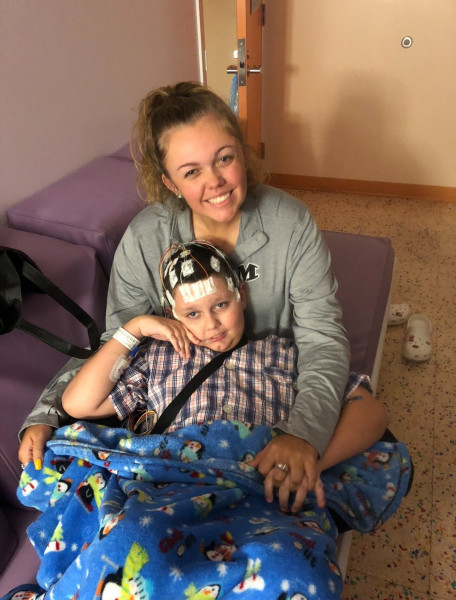 And whenever Luke had to be hospitalized at Cook Children’s Medical Center – Fort Worth, Lexi visited as much as she could. She got to know the neurology nurses, cuddled her favorite therapy dog, and watched as the staff treated Luke with innovative procedures and kindness.
Details that cater to kids made an impression on Lexi under the Blue Peaks. From the playroom to the holographic fairy on the wall … Cook Children’s was magical in her eyes.
Lexi can’t remember a time she didn’t want to be a nurse. And she found her perfect fit in February 2025 when she started working as a registered nurse in familiar territory: the Cook Children’s neurology department. No longer a visitor, Lexi made Cook Children’s her workplace home.
For more than a decade while they lived under the same roof, Lexi assisted her brother when his seizures flared up. That experience in caregiving gave Lexi a soft heart and a skillset that she now puts into practice caring for others. Seizures don’t intimidate her. She also sees the world through the eyes of patients’ siblings; she understands their questions and concerns.
“I love pediatric nursing. Children are resilient. They can go through so much, and their little bodies are so tired, but they bounce back and they handle it like champs,” she said. “I love taking care of the patients and their families, talking them through diagnosis, through treatment plans, everything.”
Lexi’s presence by Luke’s side has comforted him during countless seizures over the years. And if you ask Luke what makes his sister a great nurse, he’ll tell you: “Because she cares.”
Onset of Epilepsy
Seizures are caused by abnormal electrical bursts in the brain. Luke was 5 years old and Lexi was 11 in 2013 when his first seizure happened during a Mario Kart video game at their home in Arlington.
“I tried to hand him the remote, and he just couldn’t pay attention, and he couldn’t hear me,” she said. “I ran to get Mom in the other room, and by the time I came back, he was blue and shaking on the ground.”
Luke rode by ambulance to Cook Children’s, the first of many hospitalizations. His seizures began to occur multiple times a day, sometimes in frequent clusters that medication couldn’t control. He was diagnosed with a severe form of epilepsy called Lennox-Gastaut Syndrome (LGS).
As a teen Lexi helped their mom, Ami Waggoner, do research on Luke’s disorder. Lexi lived in the same house with her brother and parents for about 10 years after his epilepsy symptoms started. If she was around when Luke had a seizure, Lexi stepped up. She knew her role: keep Luke safe and keep him company until the seizure passed. She’d ask him to squeeze her hand or give a thumbs up if he couldn’t speak. Sometimes she’d record a video of the seizure to show his doctors.
Ami, who is also a nurse, noticed maturity and nursing traits in Lexi from an early age. A few examples:
At home whenever Luke had a seizure, Lexi knew where to find the rescue medications and the steps to follow.
As a softball player and busy teen, Lexi made time after school to hang out with Luke when he was hospitalized.
As a volunteer at monthly neurology support group for Cook Children’s families, she provided crafts and activities for children while their parents attended the meetings. The parents knew Lexi was comfortable around seizures, and they trusted her.
Lexi’s face is Luke’s favorite sight to see when he comes out of a seizure, their mom said. Lexi always responded to her brother’s medical needs by keeping her cool and encouraging him every step of the way.
Choosing Cook Children’s
Lexi worked as a patient care technician while attending the Tarrant County College nursing program. Her first nursing job was at another Fort Worth hospital. But while attending the 2024 Christmas party for neurology patient families at Cook Children’s, she realized she missed the magic. She wanted to work at Cook Children’s.
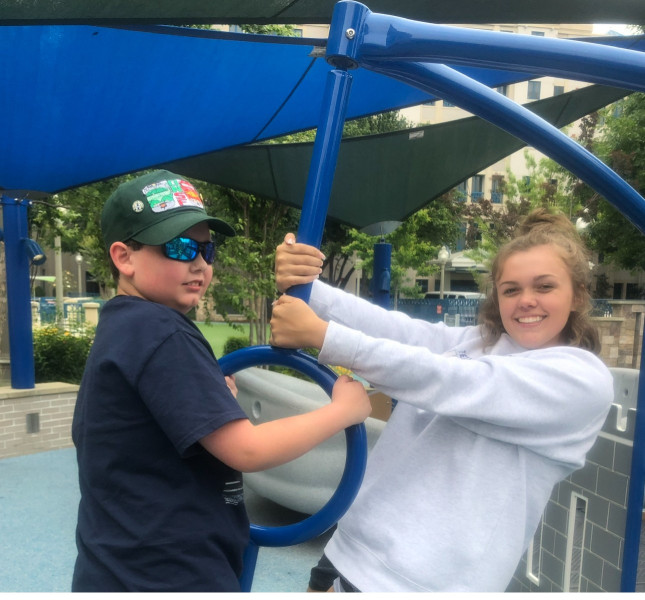 Ami remembers what Lexi said after deciding to work with pediatric patients like Luke. I think this is my place. This is what I feel like I'm made for.
When Lexi pivoted in her nursing career to join Cook Children’s Neurology, her mother saw all the pieces fall into place. “So yeah, I’m extremely proud,” Ami said. “It’s grown into this amazing thing where she wants to help so many others.”
Lexi works night shift on the medical center’s fourth floor, which includes the epilepsy monitoring unit. Some of her colleagues have helped care for Luke through the years. If Luke is admitted, Lexi can’t be his nurse.
During her teenage years she absorbed the Cook Children’s culture each time she visited her brother in the hospital. She saw nurses practicing safety, respect, generosity and other values. She felt the impact of family-centered care. Now, in a journey that’s come full circle, she’s back at Cook Children’s and paying it forward.
“I definitely have a passion for epilepsy. I have a passion for finding the cure. I have a passion for helping out the siblings on our unit as well,” she said.
When she encounters a patient’s sibling, she checks to make sure they’re OK. Lexi takes time to explain whatever medical procedure their brother or sister is undergoing, like the electrodes hooked up for electroencephalogram (EEG) monitoring.
Lisa Mayfield, RN got to know Lexi while taking care of Luke for many years on the epilepsy unit at Cook Children’s. She remembers Lexi cheering him up by bringing his favorite snacks, watching movies with him and walking with him around the unit. His seizures didn’t rattle her.
“I was beyond excited when Lexi joined our team,” Lisa said. “She has a unique prospective that she can share with her patients and their families. She has empathy and an understanding that is unique to families that live with epilepsy every day but don’t let it define them. Lexi is an amazing nurse with critical thinking beyond her years. I am excited to watch her continue to grow in the field that she has been training for her whole life.”
When a new patient comes in, Lexi wants the family to know they’ll get the best neurology care possible from a team that delivers on the Cook Children’s Promise to do everything for the child.
Celebrate the Struggle
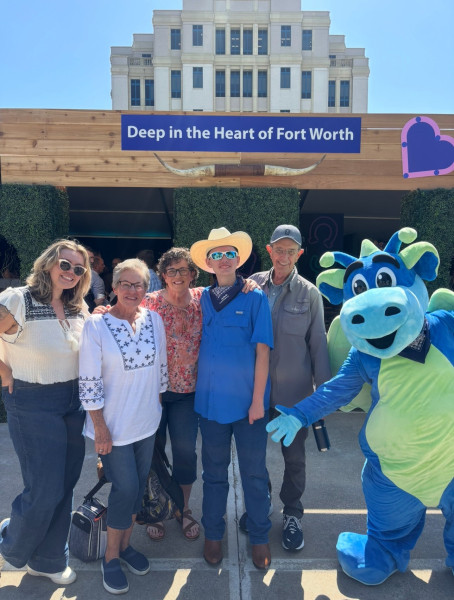 Now age 18, Luke still experiences seizures every day. But his health and quality of life have improved thanks to a 2021 surgery at Cook Children’s that implanted a deep brain stimulation (DBS) tool. DBS -- a network of devices and wires -- sends small electrical impulses to specific areas of Luke’s brain. It’s designed to keep the worst seizure activity under control.
Luke’s parents collaborate with epileptologists Cynthia Keator, M.D. and Jaehyung Lim, M.D., who oversees the DBS, and the specialists at the Jane and John Justin Neurosciences Center at Cook Children’s. They closely monitor how he tolerates different electrical amplitudes and speeds, and make adjustments as needed.
Because of DBS, Luke was able to cut back on medication. He can think more clearly. He’s more energetic.
The Waggoner family has the confidence to travel on vacations they couldn’t take prior to Luke’s DBS surgery. They appreciate the things Luke enjoys, especially trains and trips to the zoo. Their family motto? Celebrate the Struggle.
“Living with Luke taught me to make the best of any situation. He always has a positive attitude,” Lexi said. “Even though I’ve moved out, Luke is still such a big part of my life. We’re very, very close. I’m thankful that he is doing as good as he is right now, and I love to spend time with him.”
RELATED STORIES:
Brain Stimulation Curbs Teen's Worst Seizures
Teen Becomes First in North Texas to Undergo Landmark Brain Surgery for Epilepsy
Cook Children’s Neurology
Pediatric neurology deals with diseases, disorders and injuries that can affect a child’s brain, spinal cord and all associated blood vessels, muscles and nerves. If your child has a problem involving the nervous system, Cook Children’s pediatric neurologists have the specialized training and experience necessary to diagnose your child. Specialty areas include epilepsy, sleep medicine, pain management, neurophysiology, psychiatry, headaches and movement disorders. Our programs provide access to leading-edge treatments, therapies and research. Learn more here.
