

Breathing Easier: How Cook Children’s Healthy Homes Program is Reducing ER Visits
On average, families like Angelaka's who go through the Healthy Homes program have a 75% decrease in the number of emergency room visits, according to Healthy Homes’ data.
 Since he was 2 years old, Gaites Fisher has had trouble breathing. In addition to severe asthma, Gaites has a condition in which his right aortic arch compresses his trachea, making it difficult for him to breathe. His mom, Angelaka Johnson, tried everything to help; she bought an air purifier, tried to track what triggered his attacks and researched endlessly for solutions to his asthma attacks.
But despite her best efforts, Gaites still ended up being hospitalized six times between the ages of 2 and 5. Allergies or a cold would sometimes trigger the attacks, and she would quickly find child care for her other two children and rush Gaites to the hospital.
“(I felt) like I failed as a mom because I couldn't get his asthma under control. And I didn't know how to help him more,” she said. “And I always felt so defeated having to go to the hospital, knowing we’ll probably end up staying overnight.”
In June 2025, after another hospital stay at Cook Children’s, Angelaka got a phone call about a program that aimed to help her and her son with his asthma.
“I didn’t know what to expect. I thought we would just be on the phone and she would give me info that I already had; that it would be more redundant,’ she said. “And it ended up being a lot more helpful than that.”
 The Cook Children's Healthy Homes Program, which celebrated its 10-year anniversary in January, provides free resources, support and education for families and children with severe asthma. Since its inception in 2016, staff have served 1,556 children across the eight-county service area. The goal of the program is to identify and manage the source of kids’ asthma - like dust, dander or mold - and keep families from getting to the point where they need emergency care.
Marquietta Jones was formerly a Healthy Homes program coordinator for eight years and was recently promoted to care coordination supervisor.
She explained how families are brought into the program. Community health workers reach out to families who have had multiple asthma-related emergency department or urgent care visits in the previous six months. The staff reach out to the family and schedule either an over-the-phone or in-person assessment and questionnaire about their home environment and asthma history.
Over three months, families get free one-on-one support by a community health worker to identify home environmental triggers, secure supplies and services and, if needed, obtain referrals to social and medical support.
Angelaka says she was a little skeptical when Community Health Worker Cristina Cantu took her through the assessment, but she quickly realized Healthy Homes didn’t just talk about resources and support; they followed through.
“Usually when you do these things where people say they aren’t going to charge you, they make you jump through hoops to get the things you need, or it wasn’t the things you need. Where in this case, they kind of over delivered. I was surprised,” she said.
The most common triggers for asthma are respiratory infections, weather changes, pollen and dust, but it can be difficult to narrow down what factors in a home exacerbate those triggers. For example, dirty A/C vents, dusty ceiling fans and leaky sinks are all commonly overlooked household issues that can make asthma worse. A large part of the Healthy Homes program is educating families on how to identify and clean those problem areas.
Angelaka had done plenty of research on her own about how to help her son’s asthma, but he still often had flare-ups that sometimes led to hospital visits. The mother of three is a full-time graduate school student, and Gaites’ asthma and hospitalization were hard for the entire family.
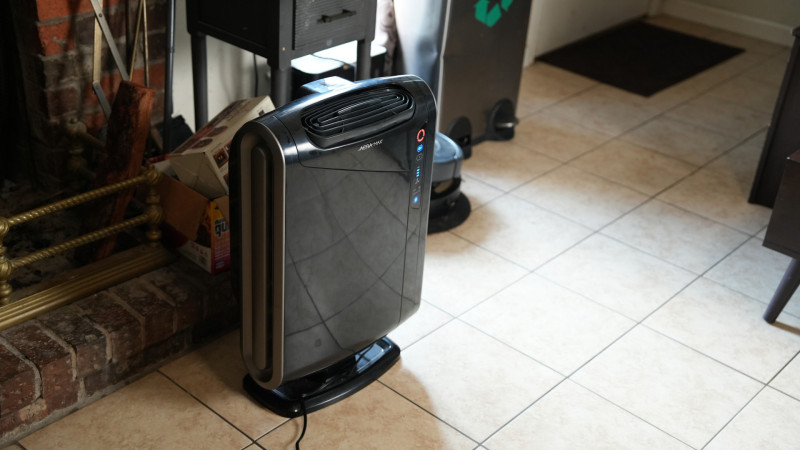 To help with Gaites’ breathing, Angelaka bought an air purifier, cleaned the house frequently, monitored his time outside when the weather changed and tried to track his triggers. So when Cantu from Healthy Homes called to talk to her about asthma, Angelaka wondered what the community health worker could tell her that she hadn’t already looked into herself.
But Cantu did not just dump information on Angelaka; she asked her questions. Through the program’s opening assessment, Cantu and Angelaka were able to figure out what she was already doing and what other resources could help further. Then, Healthy Homes provided those resources.
For example, Cantu taught Angelaka how to make her own cleaning solution that seems to be healthier for Gaites. Angelaka used to clean with a standard, store-bought cleaner and assumed any kind of dust removal was helpful for her son. But when she switched to the other cleaner made with Castille soap, vinegar, baking soda and hot water, she noticed he seemed to be coughing less.
Similarly, Angelaka didn’t realize that not all air purifiers clean the air in the way her son needs; Jones recommended an air purifier that has both a carbon and a HEPA filter. Healthy Homes gave Angelaka this more powerful air purifier, which she said has made the biggest change.
“I can’t explain enough the difference the air purifier makes,” she said. “It has definitely made a difference to me. When he’s in here, he’s playing, he’s not coughing, not sneezing. When he comes in from playing in the backyard, the air is clean in here.”
The Healthy Homes’ website includes a plethora of information and tips on identifying and managing asthma triggers.
Perhaps most importantly, Cantu gave Angelaka emotional support. Gaites is on the autism spectrum, and Cantu showed Angelaka a Facebook group for moms of children with autism. She checks in with the family about once a week and sends Angelaka info on community resources. She and Angelaka created a binder with all of Gaites’ medical information, triggers, and emergency plans that Angelaka gave to family members, babysitters and Gaites’ school.
The binder of emergency information has made Angelaka more confident that Gaites’ teachers or school nurses will be able to help him if he has a flare up. That sense of security has made it easier for her to focus in classes, because she’s not constantly worried about him.
“When you’ve exhausted all your other resources that you may know on your own to do, it's good to have a program like this that helps you find resources…so that you can be more proactive instead of reactive with those asthma symptoms,” Angelaka said.
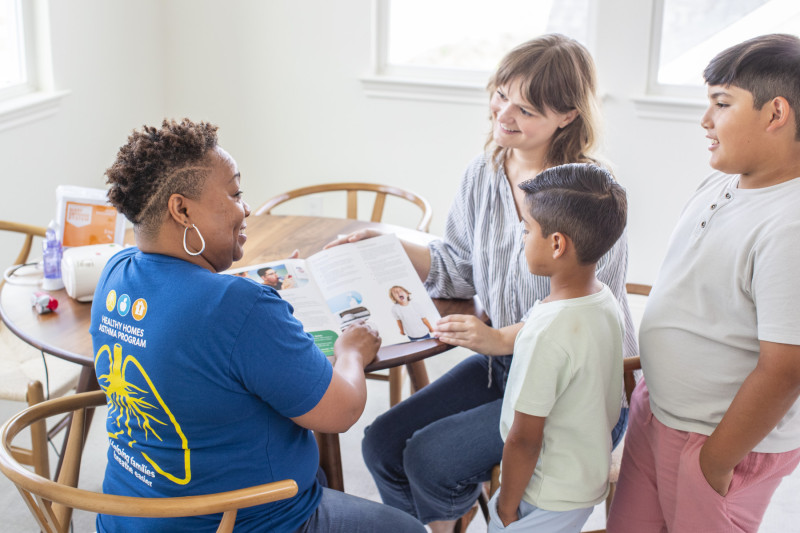 Healthy Homes is intentional about providing that all-encompassing support for families, Jones said. Aside from providing families with supplies, the program can provide resources for financial support and other basic needs. Community health workers give parents information about all kinds of community resources, not just those related to asthma. And with monthly check-ins throughout the three-month program, community health workers help families feel less isolated.
Beyond the initial improvement in child’s asthma, community health workers want families to be empowered to continue that care for the rest of their lives.
“We encourage our parents to be advocates for their child,” Jones said. “We want to be able to empower those parents to find ways to eliminate those triggers and to make sure everyone that's in contact with that child is on one accord.”
About 9% of the children in Cook Children’s eight-county service area have asthma. While serious, asthma is manageable.
For families who don’t qualify for the full program, Healthy Homes mails out information that includes a link to the Healthy Homes website. The website has videos on common asthma triggers and medication methods, as well as downloadable booklets available in nine languages.
For families like Angelaka's, the Healthy Homes program can mean all the difference for kids with asthma. On average, families who go through the Healthy Homes program have a 75% decrease in the number of emergency room visits, according to Healthy Homes’ data. In the six months since Gaites completed the program, he has not been to the emergency room at all.
This is a change, his mom said, from the two visits per year he has had since he was 2 years old.
Angelaka said she’s glad that Gaites and his siblings can focus on just being kids instead of worrying about being sick.
“Because he likes to run, he likes to run and he likes to jump. And that means a lot to me for him to just be happy and to just play without worrying,” she said.
If your child has asthma, you can check out Healthy Homes website for resources on identifying and managing asthma triggers.
