Beyond the Emergency Room: Cook Children's Takes a Stand for Suicide Prevention
Cook Children's Takes a Stand for Suicide Prevention
September is National Suicide Prevention Month, and Cook Children’s Health Care System has long been a leader in addressing mental health. Following a 44% increase in pediatric patient admissions for suicide attempts from 2015 to 2016, the psychiatry and emergency departments collaborated to implement the Ask Suicide-Screening Questions (ASQ) tool, a screening for all patients ages eight to 18, regardless of the reason they were presenting to the emergency department (ED).
Lisa Farmer, nursing director of Psychiatric Services at Cook Children's Health Care System, explains, “Just as with a medical emergency, we do not want to wait until somebody is in crisis to treat an illness.”
This proactive approach is critical, as research shows that 50% of people who die by suicide have visited a health care provider in the month prior.
A depression screening tool called the PHQ-9-M is now used in pediatric primary care, urgent care, and some specialty clinics to identify at-risk children as young as twelve. According to Farmer, this early screening is the most effective way to manage depression and suicide risk. These questions focus on whether a child is depressed and are asked to kids 12 and up. The ASQ tool is also used for children age 8 to 11 who present to urgent care with a behavioral health concern.
Through the screening tool, doctors can provide early intervention and treatment to reduce the likelihood of a crisis. Farmer says research shows the best way to manage depression and suicide risk is to provide early screening to identify those at risk.
“By seeking treatment earlier, either through psychoeducation, individual and/or family therapy and possible medication management, we are able to treat depression to decrease the risk of suicide,” explained Farmer.
According to the U.S. Center for Disease Control and Prevention, suicide is one of the leading causes of death in the United States. One person dies every 11 minutes due to suicide. Data by the CDC in 2023 shows 1.5 million people attempted suicide and 12.8 million have seriously thought about suicide.
Farmer understands parents may have concerns about talking about mental health issues and suicide with their child but emphasizes that having the conversation does not create suicidal ideation. The Academy of Child and Adolescent Psychiatry offers educational material for caregivers on multiple topics, including how to talk to your child about mental health concerns.
“At Cook, we have found that youth have expressed they feel relieved that someone has finally asked these difficult questions,” said Farmer. “It can provide assurance that somebody cares and will give them a chance to talk about problems.”
The Impact on Patients
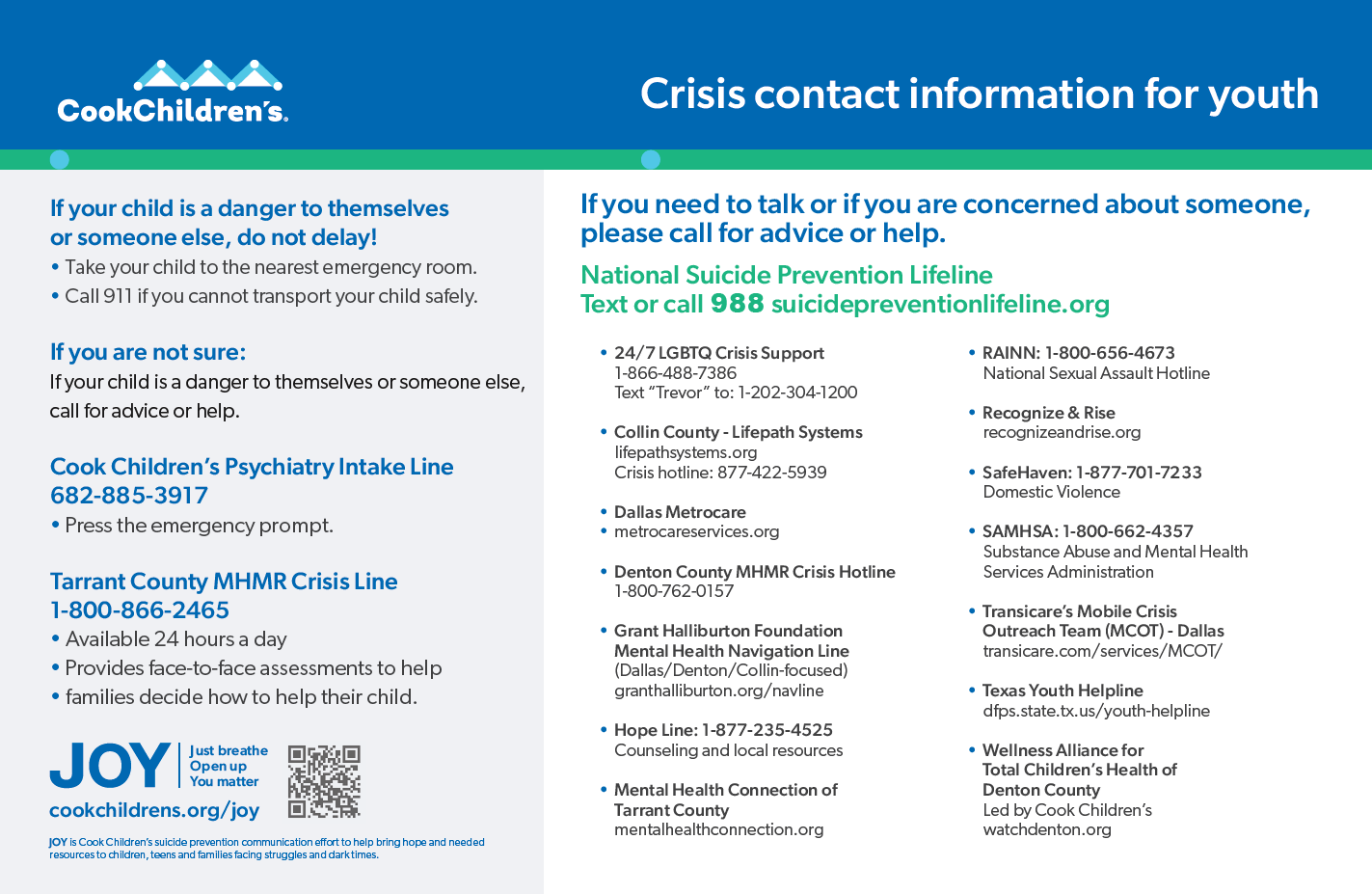
In 2024, Cook Children’s screened more than 36,000 patients who presented to the ED for non-behavioral health concerns with the ASQ tool. Of those, 848 screened positive for suicide risk. Another 2,394 kids struggling with sadness and worrying were provided with a crisis contact information sheet.