

Standing Up for Mason: Encouraging Belonging
Whitney Sizemore Henderson’s healthy pregnancy took an unexpected turn during her 34-week prenatal appointment, where doctors recognize her son Mason’s femurs were measuring small.
There were no major concerns until after birth when Mason’s pediatrician noticed his limb length was still a little shorter than normal. When Mason was one day old, the Hendersons were advised to do genetic testing.
They made an appointment with Candace Gamble, M.D. at Cook Children’s Genetics.
“Dr. Gamble was an answered prayer,” Whitney said. “She has been so patient with us and gone above and beyond to share information, answer questions and do virtual appointments since we are two hours away.”
Diagnosed with Diastrophic Dysplasia
 “One of the difficult things about a rare disorder is the uncharted territory it creates, not only for the patient and family, but also for the medical team,” Dr. Gamble said. “At Cook Children’s Genetics our physician lead team has expertise and training in recognition of rare disorders that shortens the diagnostic odyssey for our patients.”
Mason was diagnosed with diastrophic dysplasia (DTD), a type of skeletal dysplasia and a rare genetic disorder that affects cartilage and bone development in the hands, face, ears, feet, hips, legs and spine. Skeletal dysplasia can also cause dwarfism, where people are shorter in height, 4 ft. 10 in. or less on average.
“Initially, when Mason presented his condition, it was not thought to be a skeletal disorder, but he had one distinctive clinical feature that I recognized which made the diagnosis clear to me,” Dr. Gamble said. “Also, after testing is complete, our team’s experience in gene variant interpretation and resolution allows us to confirm a diagnosis faster, which is exactly what happened in Mason’s case.”
Finding Your Tribe
Fast forward to today. Mason is 3 years old and despite the challenges, has shown incredible resilience. Whitney has connected with other families online in the skeletal dysplasia community, and with variants of DTD and recessive multiple epiphyseal dysplasia (rMED).
While they haven’t found anyone with Mason’s exact gene combination or “mild” gene expression, Whitney and her husband have found solace and encouragement in the shared experiences.
“Although it can be a bit isolating because Mason doesn’t fit the standard DTD mold, seeing others be so successful in life has been encouraging us as parents to know we aren’t alone,” Whitney said.
A Team Effort for Advocacy and Awareness
Living with a rare disorder can be challenging for anyone. Like neurological disorders including autism and epilepsy, skeletal dysplasia can also be seen on a “spectrum” where some people need more medical intervention than others.
Learning about different types of skeletal dysplasia while encouraging her son to be independent has been helpful for Whitney’s family. She also recommends standing up for your child.
“I never anticipated questions and comments from strangers on Mason’s size so it pushed us to learn saying things like: ‘Kids come in all sorts of shapes and sizes!’ and ‘You are so mature.’ instead of ‘You are so big,’” Whitney said. “Changing how we speak to him and others to make it about maturity rather than size really helps. I also encourage other parents to always advocate for your kids. Only you know your kids!”
Whitney’s Passion Project: A Storybook Inspiration
Inspired by Mason’s strength and a little stuffed lion, Whitney wrote a children’s book, Little Lion, so brave and strong, to celebrate the unique qualities of children with disabilities and encourages a message of belonging.
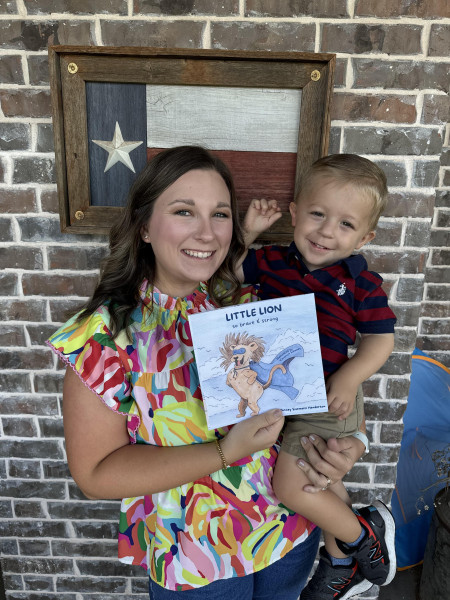 “When Mason was a baby, his great-grandma got him a stuffed lion. He loved that lion and clung to it,” Whitney said. “Each night before bed I started telling him ‘You are strong. You are brave. Like a lion!’ and we still say it together every night.”
As time went by, Whitney wondered if her routine with Mason could be something helpful for other parents and children.
“I’m not a writer, my day job is in cybersecurity so this was out of my comfort zone, but God kept nudging me to pursue it,” she said. “I told my husband and he supported the idea. Over the course of a year, we came up with ideas, researched publishing, found an illustrator and eventually self-published online.”
Whitney didn’t care if the book ever became popular, but her hope was for Mason to know that he always belongs and to pass the message to other kids.
“My favorite line from the book is ‘Little lion, so brave and strong, always know that you belong,’” Whitney said.
Dr. Gamble was also happy Whitney published a book to tell Mason’s story.
“I’m thrilled that Mrs. Henderson is a champion for Mason in writing this book and telling his story,” Dr. Gamble said. “It has been a joy to help Mason and his parents navigate this rare condition. I hope to be an advocate for them along Mason’s journey now and into the future. Our goal is to ensure that he thrives in spite of his challenges.”
