

Parents and doctors share, Navigating Cleft Diagnosis
By Brenna Kent
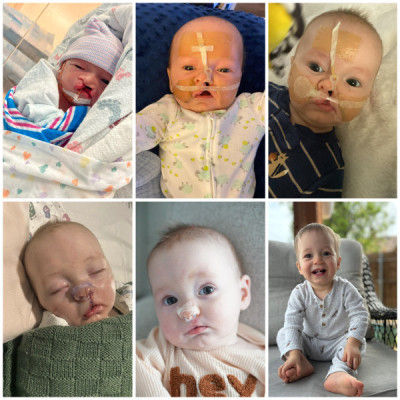 At the Butterfly Garden at Cook Children’s Medical Center in Fort Worth, Renee Woolan found some peace as she waited for her twins to complete their reconstructive surgery.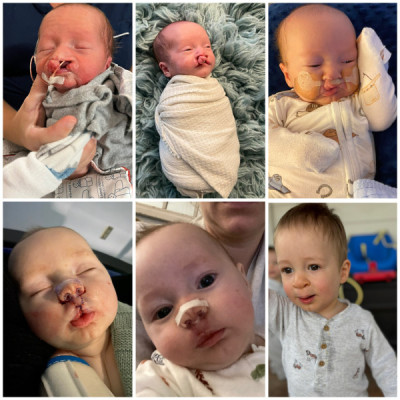
“It’s nice to have those places for parents while their children are in surgery,” said Renee, “because you're nervous.”
Bennett and Cooper Woolan were both born with a cleft lip and palate. Renee learned about their condition during a prenatal anatomy scan. She prepared as much as she could, researching and looking for the best doctors to treat her boys once they were born. Her search led her to the American Cleft Palate-Craniofacial (ACPA) certified Cook Children’s Cleft Team.
A history of high-quality care
Cook Children’s has a history of providing high-quality care to patients with cleft diagnoses. In 2024, the cleft team received formal recognition from the American Cleft Palate-Craniofacial Association (ACPA). ACPA certification recognizes teams that have achieved coordinated care across multiple disciplines for patients with a cleft, from visits with their plastic surgeons, speech and language pathologists, otolaryngologists, orthodontists, and dentists.
Cook Medical Center’s original Cleft Team was staffed by private physicians from the local community and was led by Dennis Schuster, M.D. Understanding the needs of the rapidly growing population in 2008, Eric H. Hubli, M.D., was hired as the first full-time Pediatric Craniofacial and Cleft surgeon.
Over the next decade, the program set a standard of excellence that allowed the team to grow to a point where more surgeons were needed. A nationwide search led to the hiring of two new fully trained craniofacial and cleft surgeons: Han Zhuang Beh, M.D., a craniofacial and pediatric plastic surgeon and the director of the Cook Children’s Cleft Team, and Eileen Curry, M.D., a craniofacial and pediatric plastic surgeon. Under the talented leadership and guidance of this dynamic duo, in 2024, the Cooks Cleft Team received national recognition as an ACPA-certified center. This certification recognizes teams that deliver coordinated cleft care across multiple disciplines.
Each member conveys their findings, after which a holistic treatment plan is designed to meet the unique needs of each patient.
Beyond medical care
Bennett and Cooper are now thriving toddlers.
“It’s just wild boys running around,” said Renee.
Although there is ongoing care and future surgeries, Renee is happy to see how far they have come. She knows it's only the beginning of their journey.
A child with a cleft will be cared for from infancy to early adulthood. Renee shares that the cleft team makes her feel like a key partner in her children's health.
“I know the medical side of things, I rely heavily on our families to give me insight into who their child is,” explained Han Zhuang Beh, M.D., a craniofacial and pediatric plastic surgeon and the director of the Cook Children’s Cleft Team.
As their bodies change, partnership with parents and doctors is essential. The Cleft team can help address any social or developmental concerns. Giving patients with a cleft a relatively normal childhood is the goal of the Cleft team.
"We want their cleft to be a side note, and not the center, of their life,” Dr. Beh said.
Just a little further along in his journey is Jose Martinez. Jose, who is almost 3 years old, had his cleft lip and cleft palate repaired. In April, Jose had a palatal revision.
 “He’s a very tough little boy,” said Iris Ramirez, Jose’s mom.
Jose is a rambunctious 2 1/2-year-old, and Iris knows these surgeries will not slow him down, but as a mom, there are still nerves.
Understanding this parental anxiety, Eileen Curry, M.D., a Cook Children’s craniofacial and pediatric plastic surgeon, emphasizes the importance of seeing the full picture.
“One of the first things I always try to do is share empathy with the patients and their family,” Dr. Curry said. With the Cook Children’s Cleft Team, the journey through cleft care can begin before birth, with initial prenatal consultations playing a vital role in preparing families for what is to come.
“I try to let them know, we are a team,” Dr. Curry explained.
Setting the Foundation
Cleft lip and palate occur in one in every 1000 births. Dr. Curry met Iris when she was 6 months pregnant with Jose, and Iris had just learned he would have a cleft.
“They answered the questions I didn’t know I needed to ask,” Iris said. The first-time mom admits she was nervous, but Dr. Curry helped put her at ease with her experience and answered her questions.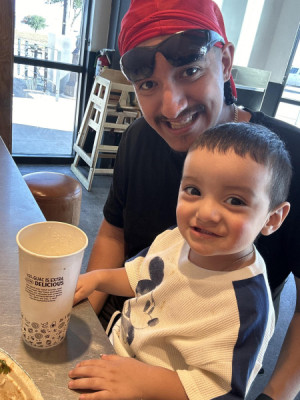
“This is how we can do care all together,” said Dr. Curry.
Dr. Beh and Dr. Curry explain that because cleft care is a journey that extends well into adulthood, establishing a relationship with parents is imperative. Doctors become part of the family, and they, too, enjoy seeing the milestones their patients make. Doctors have a chance to see their patients grow and develop into confident and accomplished young people.
“One of my favorite parts of my practice is seeing my patients find their interests and hobbies,” Dr. Beh said.
Collaborative Care
Dr. Curry explains that before the first visit, many parents tell her they have been trying everything to ensure their baby eats enough and is gaining weight, but it can be frustrating from feeding to feeding.
“It’s like if you’re drinking through a straw with a hole in it,” Renee said.
The cleft care team makes sure families visit with Speech and Language Pathologists (SLPs), who are feeding specialists, to help address those challenges. An SLP is an essential member in the multidisciplinary care of patients with a cleft. Once a patient with a cleft has fed well and gains appropriate weight, the work of an SLP is not done — they transition to monitoring their development of language and speech.
Lori Cochran, the Speech Program Clinical Coordinator, explains that children with a repaired cleft palate can develop speech errors that are unlike other children’s errors, and can change over time.
“They can sound very nasal with air escape through the nose,” Cochran said. “We work with Dr. Beh and Dr. Curry to determine if additional surgeries are needed, or if therapy alone can correct speech. It’s a very collaborative approach.”
Bennett and Cooper are in those first steps; they are starting to talk and eating solids.
“People don't realize when you don't have a palette, the first year of your life, you're practicing, you're not talking, but you're working those muscles of your tongue, you're pressing it on your palate, you're making sound,” Renee said. “Now they have one, but they're not used to it.”
She shares that her sons will likely need some speech and feeding therapy. 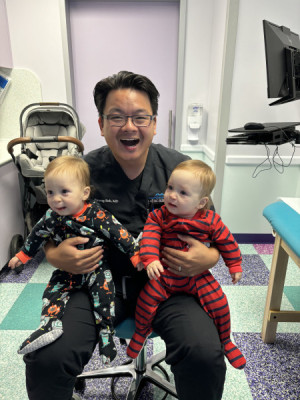
“The journey can be hard, but it also can be beautiful,” said Renee, “it strengthens you in a way you wouldn't expect.”
