

A Work of Heart: Former Patient Donates to Neuro Art Collection After Life-Changing Epilepsy Surgery
By Amber Kaiser
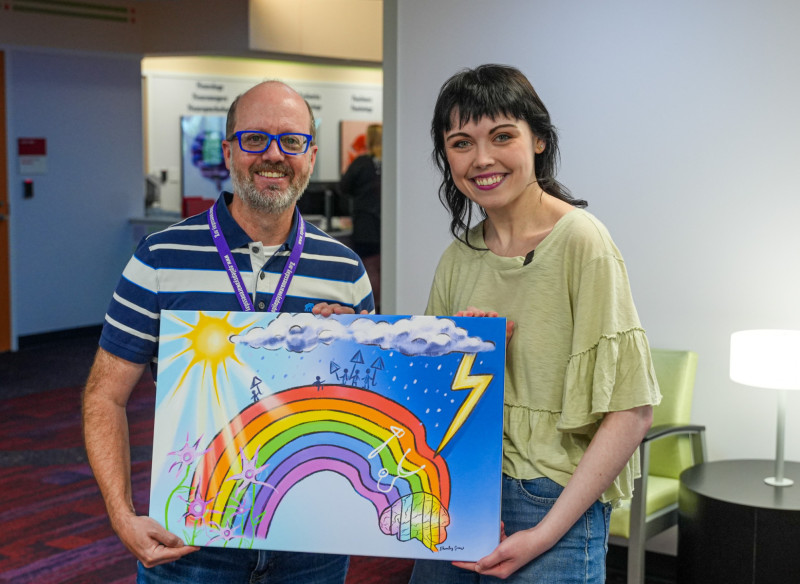 Shanley Stuteville, 25, has been a lifelong patient at Cook Children’s after she was diagnosed with epilepsy at 3 years old. When she was 19, she underwent life-changing lesionectomy surgery and hasn’t had a seizure since 2020. This year, she decided to give back to the community of patients at Cook Children’s while also pursuing her dream to help others.
Shanley was first brought to Cook Children’s by ambulance after her first seizure. She had many neurology appointments with Howard Kelfer, M.D., who became her primary care doctor.
When epilepsy surgery became an option, she also started seeing Scott Perry, M.D., pediatric epileptologist and Medical Director of Neurology for Cook Children’s. Cook Children’s has a Level 4 Epilepsy Center.
“I can’t imagine what things would’ve been like if I hadn’t had Cook Children’s on my side throughout this journey. I truly can’t say enough about how incredible the doctors and staff have been to me since I was a child,” Shanley said.
Experiencing testing in Cook Children’s Epilepsy Monitoring Unit
To pinpoint where her seizures stemmed from in the brain, Shanley stayed in the Cook Children’s Epilepsy Monitoring Unit (EMU).
“I knew when I first met Shanley that I could help her,” Dr. Perry said. “Her focal seizures were clearly coming from a single area of abnormality in her brain that I felt confident we could safely remove.”
Staying a few days in the EMU can be scary and Cook Children’s does all they can to make the experience feel as safe as possible. Shanley has a loving support system of family and friends, which makes all the difference in experiencing life with seizures, the side effects of seizures and medications, and the limitations that epilepsy can bring.
“Whenever I would have to stay up all night prior to the EEG testing, my family would make a fun themed party out of it and we would stay up watching movies and playing games. My friends also came to visit and everyone’s support made all the difference for me,” Shanley said.
Having epilepsy surgery
Shanley went through necessary testing to be considered for epilepsy surgery of a lesionectomy, which removes a lesion or abnormality in the brain. For a long time, she thought she would never be a candidate so when she found out she was, she and her family were so grateful they had finally found hope to control her seizures.
“I had never been so confident that I wanted to do something in my entire life. To have a chance of recovering from epilepsy was incredible and something I couldn’t pass up,” she said.
The surgery process went smoothly for Shanley and even Dr. Perry noticed how comfortable she felt about the surgery.
“I recognized immediately her engagement in the surgical process and how she could change how people view epilepsy surgery when she shared her plans to create a children’s book about visiting the epilepsy monitoring unit,” Dr. Perry said. “The book she and her aunt created was amazing.”
How epilepsy surgery changed Shanley’s life
Shanley has been seizure-free since July 2020. It has been a wonderful four years for her with some challenges as well. Deciding to slowly reduce epilepsy medication after brain surgery is common for a lot of people and she experienced side-effects like anxiety as well as learning how to suddenly live her life without epilepsy anymore. She had to grow her inner confidence again and learn how to live with how her brain worked differently.
Even with the challenges, she’s so glad she chose to have surgery and experience the transformation it has made in her life. In fact, she is currently studying and plans to graduate with a Master’s degree in psychology in May 2025.
“To see her all these years later, seizure-free and living out her own dreams means everything to me,” Dr. Perry said. “Personally, it gives meaning to what I do daily. But to then know she is pursuing psychology is even more impactful given how often children with epilepsy need the services of psychology. I can only hope we get Shanley to come back to work for us.”
Shanley’s love of art and donation to the “neuro art collection”
Shanley has been creating art since she was very young. Her favorite kinds of art include mixed media illustrations with colored pencils and gouache paint, or digital art like the piece she created for the “neuro art collection” at the Jane and John Justin Institute for Mind Health which was started by Dr. Perry.
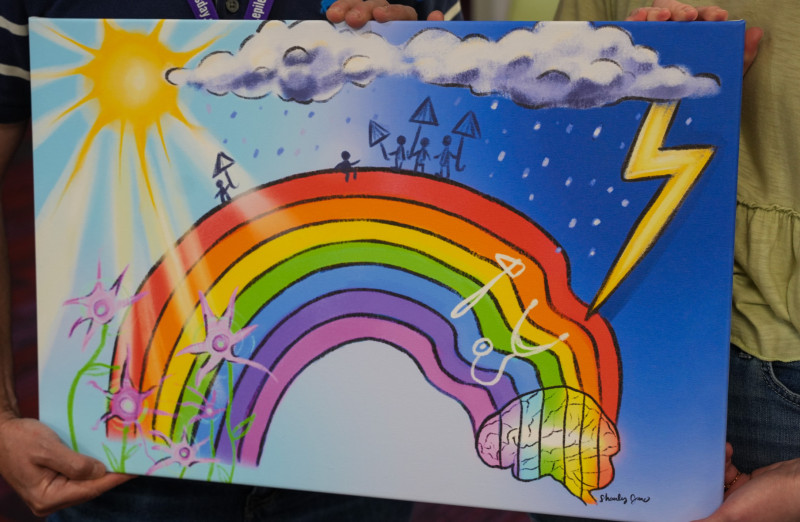 “Shanley’s donation to the neuro art collection is exactly what I envisioned when my wife and I first commissioned the original art collection. I knew that the neuroscience community was full of artistic and creative people. I knew their art could inspire others and I hoped that my own patients would one day give back to our collection. Shanley is the first former patient to contribute her talents to our collection and the first former patient to benefit all the patients that come behind her,” Dr. Perry said.
Shanley’s intention with the piece she’s donating is to give people the feeling of hope. With her experiences living with epilepsy, her surgery and all of the ups and downs of life, she’s always tried to look for the “rainbow after the storm” and hopes to convey that in her art.
Hope for the future and advice for people battling epilepsy
With her goal of getting a degree in psychology next year, Shanley plans to have the opportunity to work with children who have chronic neurological disorders like epilepsy. For a long time, doctors have only treated epilepsy symptoms, not the emotional, social and psychological challenges that living with epilepsy creates. She also wants to help people who’ve had challenges readjusting to life after their long-term disorder is suddenly gone.
Shanley thinks it’s important for people battling epilepsy to remember they are not their disorder. Living with epilepsy and experiencing surgery has helped Shanley become even more empathetic. She encourages people to look for the positive and for opportunities wherever they can, to lean into what they love and to remember that they aren’t alone.
Jane and John Justin Institute for Mind Health at Cook Children's
 Kids with neurological disorders often face many challenges—and see many specialists. For many families, that means multiple visits to different locations. At Cook Children's, we're changing the way we deliver care by making their journey easier. How? By opening the doors to care that's centered around the unique needs of our patients and their families.
Introducing the Jane and John Justin Institute for Mind Health at Cook Children's—bringing together nine specialties under one roof. Pediatric specialists in neurological, developmental, and behavioral health are changing the way we deliver health care. Together, we're healing minds and bodies, sharing smiles that warm the soul, and connecting care for kids unlike anyone else. Learn more about The Justin Institute.
