

Survey Highlights Health Concerns in the Community
Parents and caregivers voiced a range of challenges, including food insecurity and gaps in caregiver support, in a comprehensive new survey of issues impacting the health of North Texas children.
Cook Children’s Center for Community Health conducted the 2024 Community Health Needs Assessment (CHNA) to identify and prioritize health needs and resources available for children in the service area. The results indicate a complex set of factors that create obstacles in caring for children and accessing health services.
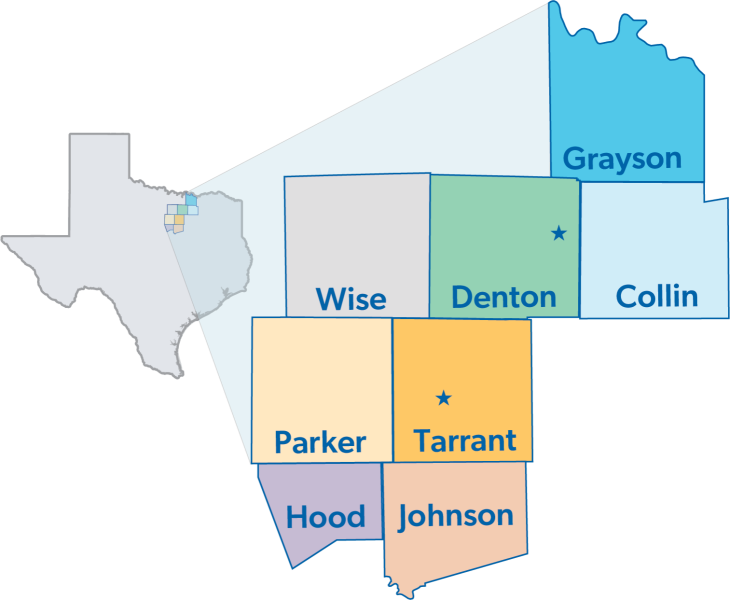 Every three years, the center compiles the CHNA by surveying and interviewing parents and caregivers in Cook Children’s service area. Survey responses came from more than 7,300 parents, caregivers, and community leaders in Collin, Denton, Grayson, Hood, Johnson, Parker, Tarrant, and Wise counties. That region encompasses almost 1.2 million children (0-17 years), according to U.S. Census estimates.
KEY FINDINGS
The 2024 survey showed about 390,100 children from birth to 17 years old live in households that sometimes or often couldn’t afford nutritious meals.
Along with food insecurity, about 287,100 children have a caregiver who shared that they were unable to receive all needed health services for their child. Reasons cited include lack of insurance, high health care costs, transportation difficulty and the financial impact of parents missing work for their child’s medical appointments.
Barriers played a role in 139,600 children ages 1-17 not receiving needed dental care, and 79,900 children ages 6-17 going without needed mental health services. Immunization levels in the service area showed 89% of children up-to-date on vaccines.
“What stands out most is how many families are dealing with overlapping challenges that all affect their children’s health and well-being,” said Mandy Wolever, Ph.D., Research/CHNA Manager at the Center for Community Health. “Caregivers shared that they’re constantly making tough choices -- between covering basic needs like food, housing and utilities——and trying to get their children the health care they need.”
Fewer caregivers reported they have a source of emotional support for raising their children. That finding aligns with the U.S. Surgeon General’s advisory in August 2024, calling attention to parental stress due to financial instability, work-life balance, lack of social support and other factors.
The struggle to put nutritious meals on the table or visit the pediatrician adds another layer of stress that impacts a child’s health and development, Wolever said.
The top three health needs reported by caregivers were preventive health care, treatment for short-term illnesses and immunizations. Mental health care or counseling topped the list for community leaders, followed by wellness opportunities and preventive dental care.
Other takeaways from the parent/caregiver survey include:
- Eighty-four percent of children in the service area had “excellent” or
“Very good” health in 2024. That compares to 87% of children across Texas and 90% of children in the United States in 2022. - In the past year, 1 in 5 children (about 217,700) in the service area experienced chronic or frequent dental problems. Children with poor or fair oral health are twice as likely to miss school due to dental problems.
- Approximately 237,000 children ages 6-17 have a diagnosed mental health condition such as anxiety, depression, or attention-deficit/hyperactivity disorder, according to their caregiver. Two out of every 5 children (about 304,100) have been bullied at school.
- Approximately 233,300 children received emergency care for an accidental injury.
- Asthma impacts 104,500 children in the service area. Asthma symptoms sent about one-fourth of those children to a hospital emergency department in the past year.
- Almost 90% of children had continuous health insurance coverage for 12 consecutive months before completing the survey.
FROM DATA TO ACTION
 These results, along with many other survey data points, give context to the center’s key priorities: children’s overall health and well-being, asthma, healthy lifestyles, caregiver support, injury prevention, mental health and oral health.
Becki Hale, AVP at the Center for Community Health, said takeaways from the survey will help the center respond to evolving needs in collaboration with more than 700 organizations across the region.
“We’re incredibly grateful to be part of such a strong, compassionate health care organization that invests and prioritizes giving back to the community and helping families thrive,” Hale said. “We also recognize that Cook Children’s is one of many partners committed to improving the health of our communities. Today’s health and social needs for families are too complex for any one entity to address alone. It takes all of us, working together.”
One example of how Cook Children’s utilizes the CHNA results in collaboration with others to implement innovative approaches that address the greatest needs: the Center for Community Health teamed up with Texas Health Resources in January 2025 to open a Good For You Healthy Hub at Fort Worth’s Eastside YMCA. The hub provides fresh fruits, vegetables and other nutritious foods for free to residents of the Eastside neighborhood.
Chris Pedigo, senior vice president of system planning, health analytics and the Center for Community Health, pointed out that the CHNA provides insights that help Cook Children’s keep its Promise to improve the well-being of every child in our care and communities.
“Our next steps include comparing this year’s results to those of previous years to identify areas where we’ve seen change, as well as identifying new communities that need focused programming,” Pedigo said.
Surveys were collected from a sample of households across the service area at large, not just Cook Children’s patients. Surveys were also collected from parents of special under-resourced populations, including those experiencing homelessness or living with an undocumented family member. The results are weighted to represent the actual population of children living in the service area.
The center takes steps to include a cross-section of the population through data collection and interviews. The team analyzed approximately 1.2 million data points, said Lauren Purvis, MPH, CPH, MCHES, Director of Child Health Evaluation.
“This approach can help partners feel confident using our data to inform their organization’s strategies to improve children’s health in their communities,” Purvis said.
Significant effort goes into developing and carrying out the research strategies that make the CHNA as inclusive and representative as possible.
 “It’s important to us to gather a wide range of perspectives so we can thoroughly assess community needs,” Wolever said. “This approach helps us better understand how to support families and improve the well-being of children, ultimately living out our Promise.”
Regional Summits
Cook Children’s Center for Community Health is hosting two free, virtual Child Health Summits to share the survey findings with the media, community partners and other professionals.
- Part 1, May 6, 9-10:30 am: Cook Children's Child Health Summit Part 1 Registration, Tue, May 6, 2025 at 9:00 AM | Eventbrite
Focus areas: Overall Health and Well-being, Asthma and Healthy Lifestyles
- Part 2, June 3, 9-10:30 am: https://www.eventbrite.com/e/cook-childrens-child-health-summit-part-2-registration-1095338770749?aff=oddtdtcreator
Focus areas: Caregiver Support, Injury Prevention, Mental Health and Oral Health
For more survey results, please visit the data dashboard or contact CHNAFeedback@cookchildrens.org.
RELATED STORY
Cook Children’s Center for Community Health
Cook Children’s Center for Community Health encourages strong partnership support and engagement throughout our eight-county service area. Our community partnerships promote understanding, resources, and education on children’s health issues. Since 2009, we've conducted triennial Community Health Needs Assessments (CHNA) to identify key issues and guide interventions. Prioritized from our first formal assessment, we continue to strengthen our focus on asthma, caregiver support, healthy lifestyles, injury prevention, mental health, and oral health. Learn more here about opportunities to collaborate.
